
" Proudly Veteran-Owned & Women-Owned. Built on integrity, service, and a commitment to helping businesses succeed."
Better transaction data can create better payment outcomes.
For businesses that accept commercial, purchasing, corporate, or government cards, optimization starts with accurate qualification, complete enhanced data, and technology that can transmit it consistently.
- Data-quality review
- Gateway-aware configuration
- Ongoing monitoring
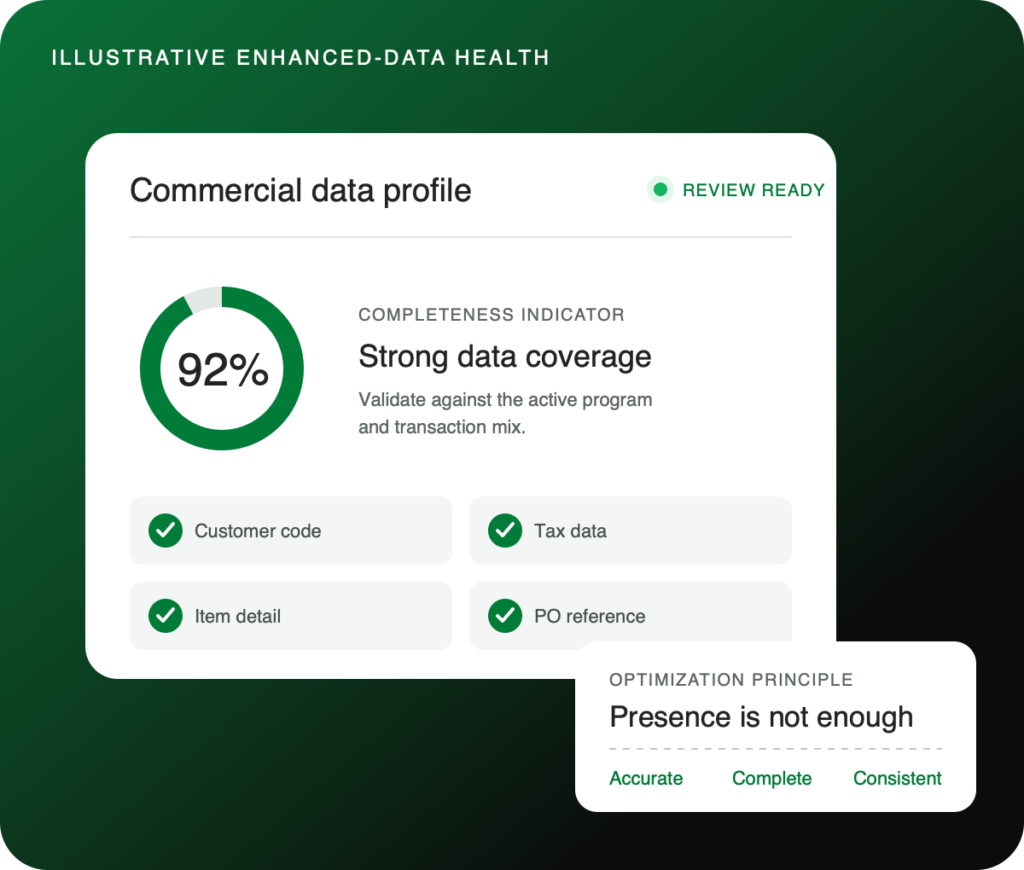
 Review How Transactions Qualify
Improve Enhanced-Data Quality
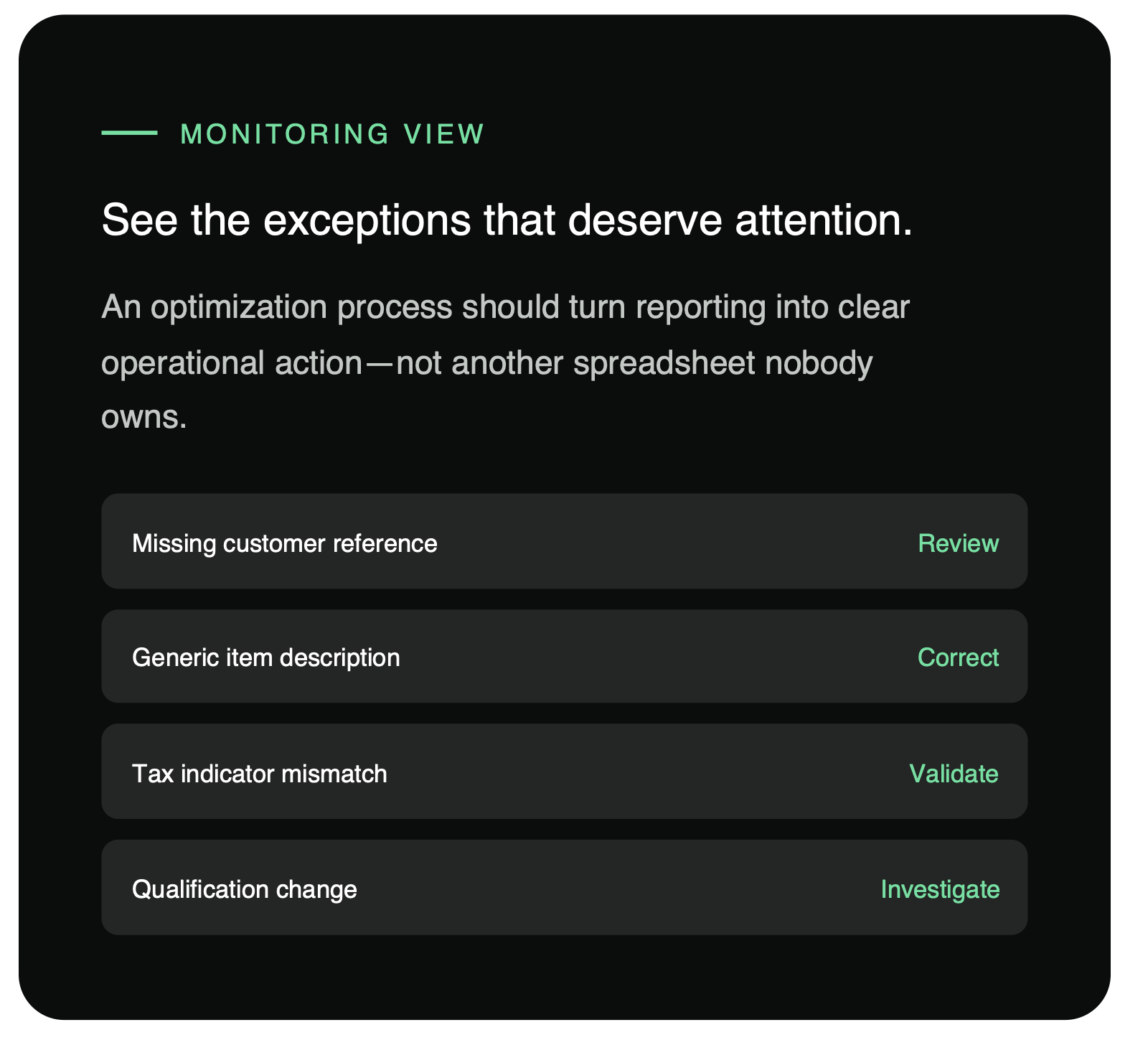
Track Results After Launch
Commercial-card costs are shaped before the transaction settles.
Card type, transaction environment, merchant setup, authorization and clearing data, gateway capabilities, and network requirements can all influence how an eligible transaction is evaluated.
Identify eligible activity
Understand where commercial cards appear, which channels are used, and which transaction types deserve closer review.
Strengthen the data
Capture meaningful customer, tax, invoice, freight, and line-item details instead of relying on generic or placeholder values.
Monitor qualification
Review interchange outcomes, validation feedback, downgrades, and adjustments so problems can be corrected—not repeated.
A shift from “data present” to data that can be evaluated.
Visa’s Commercial Enhanced Data Program reorganizes enhanced commercial-card qualification around data quality and merchant verification. The practical priority is to send accurate, complete, transaction-specific information through a capable payment stack.
Merchant Outcome
Verified or Non-Verified
Optimized Path
Product 3 Qualification
Operational Focus
Data Quality + Monitoring
01 / VALIDATION
Accuracy matters alongside completeness.
Commercial data should reflect the real transaction. Placeholder descriptions, inconsistent tax handling, and incomplete line items can undermine optimization.
Status must be visible and understood.
Merchants and their payment partners need a reliable way to determine whether submitted data is meeting current program expectations.
Results may require follow-through.
Qualification, validation issues, and subsequent adjustments should be reviewed within regular payment-cost and reconciliation processes.
Optimization cannot depend on workarounds.
Documented field mapping, source-system ownership, staff procedures, and change management help keep data dependable as the business evolves.
Build a clean path from order detail to clearing record.
The exact requirements vary, but commercial-card optimization commonly depends on a connected set of summary and line-item data.
Customer References
Connect the payment to the buyer's internal workflow.
- Customer Code
- Purchase Order or Invoice Reference
- Order Identifier
Tax information
Represent applicable tax and tax-exempt handling accurately.
- Tax Amount
- Tax-Exempt Indicators
- Local or Transaction Tax Treatment
Line-Item Detail
Describe what the customer actually purchased.
- Product or Service Description
- SKU or Item Identifier
- Extended Line Amount
Quantity and Unit Detail
Keep units and amounts internally consistent.
- Quantity
- Unit Cost
- Unit of Measure Where Applicable
Freight and Duty
Separate additional commercial amounts when required.
- Freight and Shipping
- Duty Amount
- Destination Information
Merchant and Transaction Setup
Support the data with the right account and payment configuration.
- Merchant Identifiers
- Transaction Type and Channel
- Gateway Field Mapping
Every handoff has to preserve the transaction story.
Optimization depends on more than what is entered at checkout. The data must be captured, mapped, transmitted, evaluated, and reconciled across the payment chain.
01 / SOURCE
Order or invoice
Business systems create the customer, tax, purchase, and line-item detail.
02 / CAPTURE
Payment interface
POS, ERP, ecommerce, invoice, or virtual-terminal workflows collect the fields.
03 / TRANSMIT
Gateway & processor
Field mapping and platform support carry the enhanced data forward.
04 / EVALUATE
Network qualification
Eligible transactions are assessed under the applicable rules and program.
05 / REVIEW
Reporting & action
Outcomes, validation feedback, downgrades, and adjustments inform corrections.
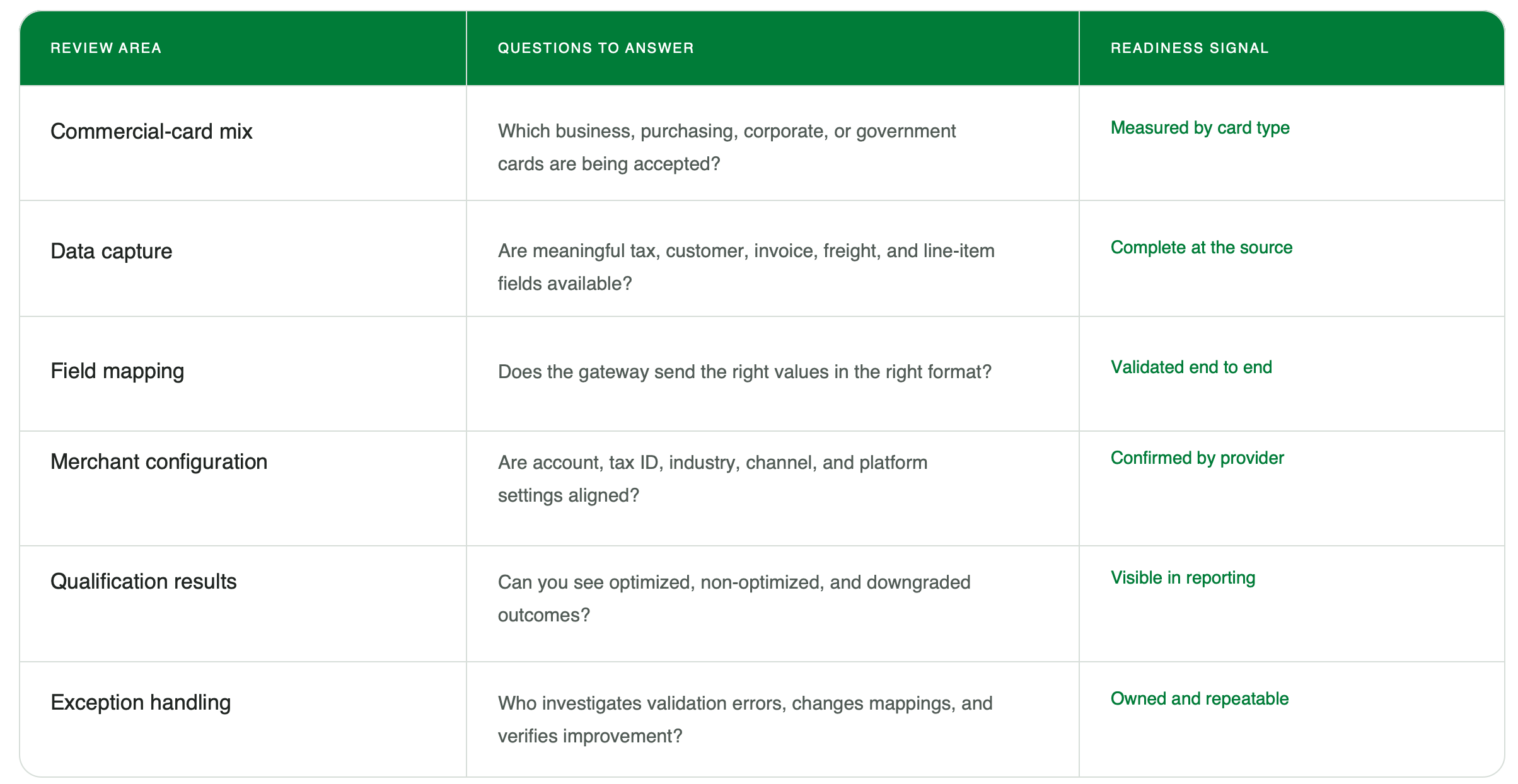
Know where your optimization process is strong—and where it breaks.
A focused review follows a representative transaction from the source system through the merchant statement and looks for gaps at every stage.
Built for businesses with meaningful commercial-card volume.
Wholesale & distribution
High-ticket orders, repeat buyers, invoice references, freight, and detailed product data.
Manufacturing & industrial supply
Commercial purchasing cards, complex SKUs, unit pricing, tax, and shipping detail.
B2B services
Invoice-driven payments, purchase orders, project references, and repeat commercial clients.
Government suppliers
Purchasing-card acceptance with strong documentation and tax-exempt workflows.
Healthcare & professional organizations
Commercial payments that may flow through invoicing, virtual terminal, or ERP systems.
Multi-location commercial sellers
Consistent data mapping, merchant setup, reporting, and accountability across locations.
Move from assumption to a documented improvement plan.
STEP 01
Baseline the portfolio
Review statements, commercial-card mix, ticket size, channels, downgrades, and current enhanced-data activity.
STEP 02
Trace the data
Follow key fields from POS, ERP, ecommerce, invoicing, or virtual terminal through the gateway and processor.
STEP 03
Configure and test
Correct eligible mappings and settings, then use controlled transactions to confirm expected transmission and reporting.
STEP 04
Monitor and refine
Review qualification and exceptions on a recurring basis as rules, systems, products, and business processes change.
Your gateway should make enhanced data easier to manage.
Supported platforms may provide field prompts, product configuration, CEDP indicators, checklists, virtual-terminal workflows, and reporting that make commercial data more visible.
- Required-field prompts
- Purchase-order capture
- Virtual-terminal support
- Qualification visibility
- Product and item configuration
- Tax and exemption handling
- Transaction-level reporting
- Exception follow-up
A payment partner that connects the financial and technical details.
Q Solutions is a Veteran-Owned and Women-Owned company focused on clear recommendations, dependable implementation, and support that continues after configuration.
Statement and transaction analysis
Identify where commercial cards, downgrades, and data-related opportunities appear in the current payment environment.
Processor and gateway coordination
Confirm which features, fields, reports, and workflows are supported before promising an outcome.
Plain-language implementation guidance
Translate technical field requirements into practical responsibilities for sales, billing, operations, finance, and IT teams.
Ongoing review
Help monitor results and revisit configuration as network requirements, platforms, or business workflows change.
Clear answers about commercial-card optimization.
What is commercial-card optimization?
It is the process of aligning eligible commercial-card transactions, merchant configuration, enhanced data, gateway capabilities, and reporting with applicable network qualification requirements. The goal is accurate processing and better visibility into interchange outcomes.
What is Visa CEDP?
Visa’s Commercial Enhanced Data Program is a framework for evaluating enhanced data on eligible commercial-card transactions. It emphasizes accurate, complete data and merchant verification for Product 3 qualification. Exact eligibility and requirements must be confirmed with the processor or acquirer.
Is CEDP the same as traditional Level 2 and Level 3 processing?
CEDP evolved Visa’s U.S. enhanced-data approach. Older terminology is still widely used operationally, but the current program focuses on validated enhanced data and Product 3 qualification rather than simply detecting that Level 2 or Level 3 fields are present.
What information may be needed?
Depending on the transaction and program, relevant fields can include customer or purchase-order references, tax information, product or service descriptions, item identifiers, quantities, unit costs, extended amounts, freight, duty, and merchant identifiers.
Does submitting enhanced data guarantee a lower rate?
No. Qualification depends on card type, transaction eligibility, merchant setup, authorization and clearing data, processor and gateway behavior, network rules, and the accuracy of the submitted information. Savings and outcomes are not guaranteed.
Can optimization work with a virtual terminal or invoicing workflow?
Potentially. Some supported gateways and virtual terminals include enhanced-data prompts, product fields, purchase-order capture, tax handling, and CEDP-related indicators. Capabilities vary by platform and configuration.
How do I know whether transactions are qualifying correctly?
Review requires processor reporting, interchange detail, validation feedback when available, and representative transaction testing. Merchant statements alone may not show every data-quality issue clearly.
How does Q Solutions help?
Q Solutions can review the current payment environment, identify commercial-card activity, coordinate supported processor and gateway capabilities, guide configuration and testing, and help establish a repeatable monitoring process.
Ready To Improve Your Business Operations?
Partner with Q Solutions to streamline operations, reduce costs, and equip your business with technology built for growth.
- No setup fees
- Month-to-month
- Cancel anytime